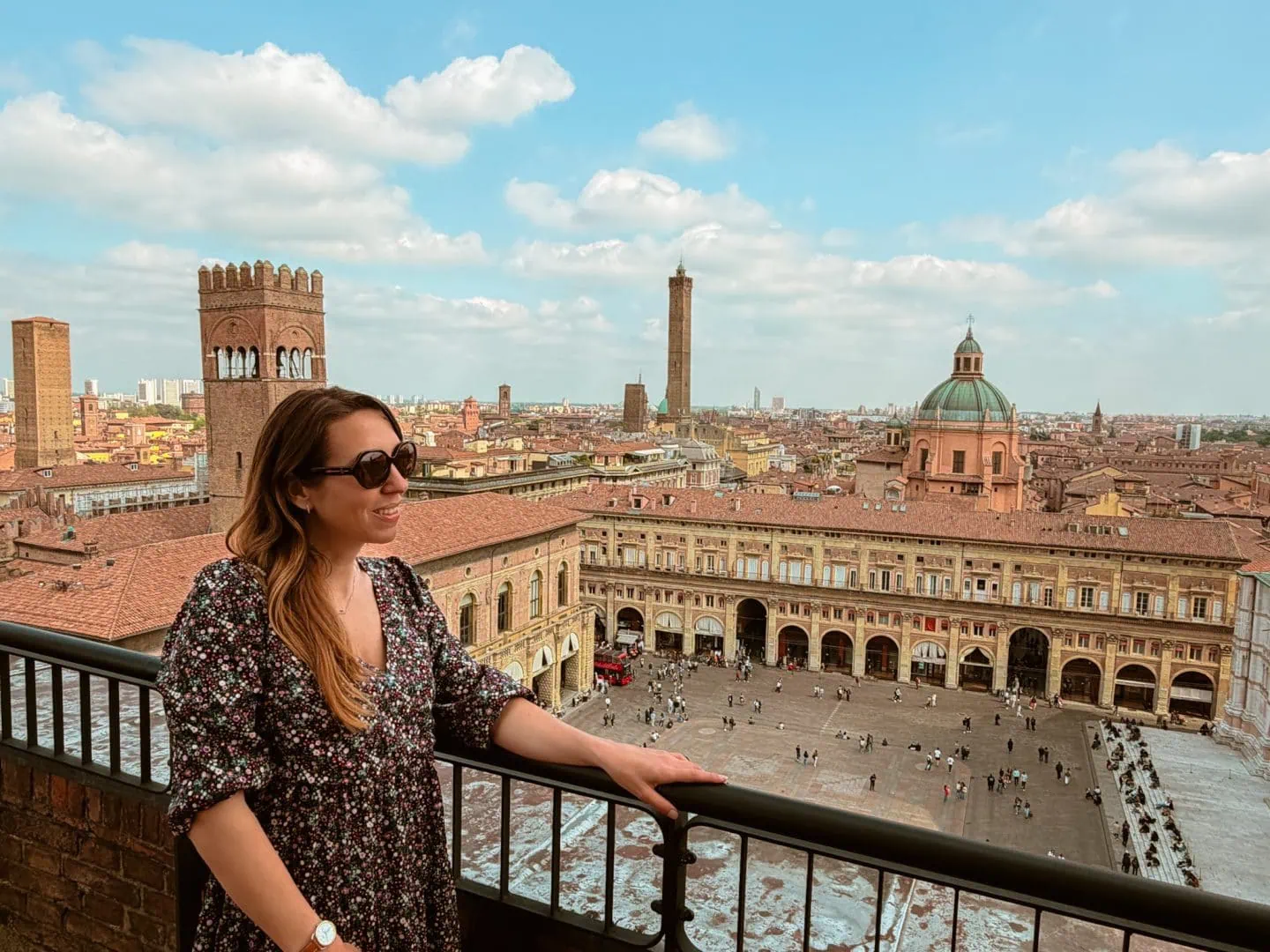
I’ve taken the Florence–Bologna train enough times to know what actually makes a Florence to Bologna day trip by train successful. I also know what completely wastes your time. Short answer: Bologna is perfect for a slow one-day visit from Florence. But only if you stay in the historic centre, book your key visits in advance, and resist the temptation to chase every famous photo spot on the map like the Finestrella di Via Piella canal window. In this guide, I’ll show you exactly how I spent a full day in Bologna Italy without rushing. From stepping off the train to the last rooftop view, including the 5 places that are actually worth your time. Where I ate lunch, and the simple mistakes that can easily ruin the flow of the day.
I stepped on the train at 9.25 am at Florence Santa Maria Novella. The train doors close, and within minutes, the landscapes of Tuscany start to blur past the window. Less than 40 minutes later, at 10.03 am I step out into a completely different atmosphere. Bologna feels calmer, more local compared to the intensity of Florence.
Because yes, Bologna is perfect for a day trip. But only if you do it right.
On the move from Florence to Bologna Italy
I left Florence at 9:25 am from Santa Maria Novella, fresh orange jus in hand. By the time the train pulled out I already knew I had timed the day right, early enough to avoid rushing, but not so early that it felt painful.
The high-speed ride to Bologna takes just under 40 minutes, and I paid €20 one way by booking a few days in advance. I’ve seen the same seat go for €55+ when booked last minute, so I wouldn’t gamble with it if you already know your dates.
The train left on time, and I just sat there watching fields and small towns drift past the window while the day slowly started outside. I always take a morning train for this exact reason. Arriving before 10:00am gives you a full day in Bologna without that slightly stressful feeling of racing visits, lunch reservations and closing times.
Arriving at Bologna Centrale railway station, I decided to walk. The historic centre is only about 15 minutes away on foot, and it’s one of those walks that slowly introduces you to the city. The streets become narrower, the buildings warmer in colour, and before you know it, you’re standing right in the heart of Bologna at Piazza Maggiore. It’s the perfect start to the day, just letting the city reveal itself.
Planning a day in Bologna Italy (even if you’re not a planner)
I’m not someone who usually plans trips in detail. I prefer to walk and adjust as I go. But for a day trip to Bologna, I realised quickly that a loose approach only works up to a point.
I had planned buy tickets in advance for Palazzo dell’Archiginnasio and Torre dell’Orologio, but when I checked availability that morning. I wanted to start my day with the Torre dell’Orologio, but tickets were only available in the afternoon. It wasn’t a disaster, just a reminder that on a one-day visit timing is important.
One thing I didn’t expect was how much of the experience now runs through my phone. QR-code audioguides, tickets, navigation, photos. By the time I’d done two longer visits at different points in the day, my battery had dropped faster than expected.
Tip: a full battery (or a small power bank) matters more than over-planning the route.
The must-see places in Bologna Italy (with tips from a local)
Before going to Bologna, I asked one of my Italian teachers in Florence, Giuseppe, for his personal recommendations. He lives in Bologna, so I trusted his advice more than anything I could find online. Here are the 9 things to see in Bologna he told me not to miss.
9 must-see places in Bologna (and one you definitely want to skip)
- Piazza Maggiore
- Piazza Nettuno and its fountain of the same name
- Palazzo dell’Archiginnasio
- Palazzo d’Accursio (the town hall of Bologna)
- Torre dell’Orologio (the clock tower)
- Museo della Storia di Bologna (Museum of the History of Bologna)
- Basilica di San Petronio
- Santo Stefano complex
- Sanctuary of San Luca
I’ve become more of a slow traveller. I’d rather see fewer places and truly enjoy them than hurry from one attraction to another. No strict schedules, no rushing. Just taking the time to feel a place, notice the details, and leave space for the unexpected. That wasn’t always the case. I used to travel with a checklist in mind, trying to see everything in one day. I wouldn’t even stop properly for lunch, just grabbing something quickly between visits.
The good news? In Bologna, you can actually do both. Take your time and see the essentials. What surprised me most was how compact this Italien city felt. Almost everything I wanted to see was within walking distance, centred around Piazza Maggiore. It quickly became my reference point throughout the day; I kept finding my way back there without even realising it.
The only place slightly outside the centre is the Sanctuary of San Luca. I decided to skip it on this first visit. But if you prefer a more “complete” itinerary, you can easily include it by taking the City Red Bus (hop-on hop-off). Make sure to book it on the official Bologne Tourist Information website for the best price: 16€, duration 1 hour.
Booking my tickets (and why it changed my day)
For this day trip, I decided to book just two visits in advance. One in the morning and one in the afternoon. I chose Palazzo dell’Archiginnasio and the Torre dell’Orologio, both located right in the heart of the city.
You can book tickets online via the official tourist information website. I would highly recommend doing this a few days in advance, especially if you’re visiting during busy periods.
I also booked a restaurant for lunch. That’s something I never skip anymore after a previous experience in Siena, where I ended up walking around for ages without finding a table. Lesson learned.
A perfect day trip to Bologna: how my visit unfolded
Before arriving in Bologna, I only booked three things: two visits and lunch. Beyond that, I wanted to see how much of Bologna could be discovered naturally in a single day. Some places, like Piazza Maggiore or the Basilica of San Petronio, appeared almost effortlessly as I walked through the historic centre. Others were spontaneous discoveries I hadn’t planned at all.
I was also curious to see whether some of Bologna’s most famous attractions were actually worth the hype. One of them, the Finestrella di Via Piella, definitely wasn’t. I visited it, took a quick look, and left convinced that there are far better ways to spend your limited time in the city.
Piazza Maggiore and Piazza Nettuno
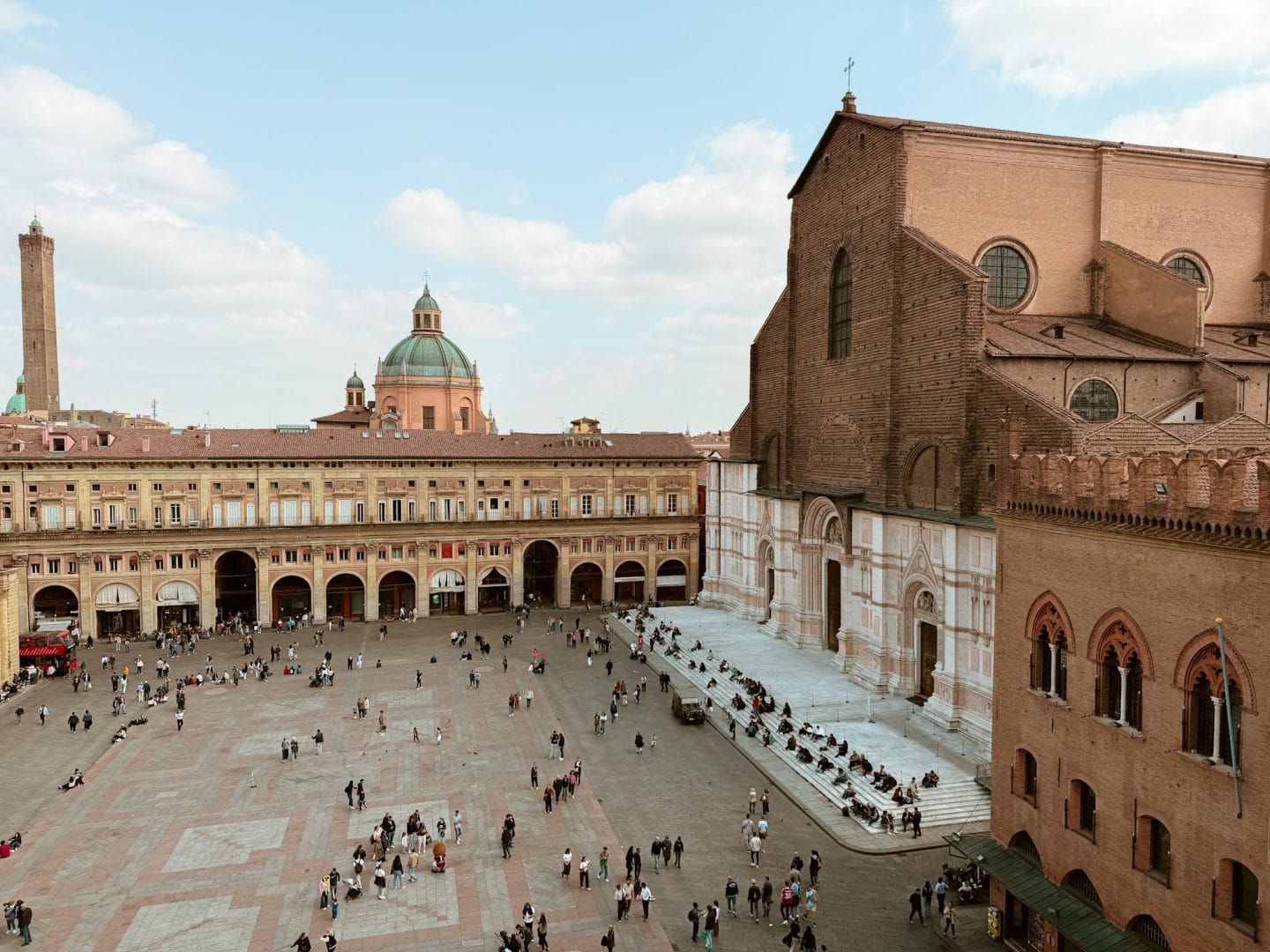
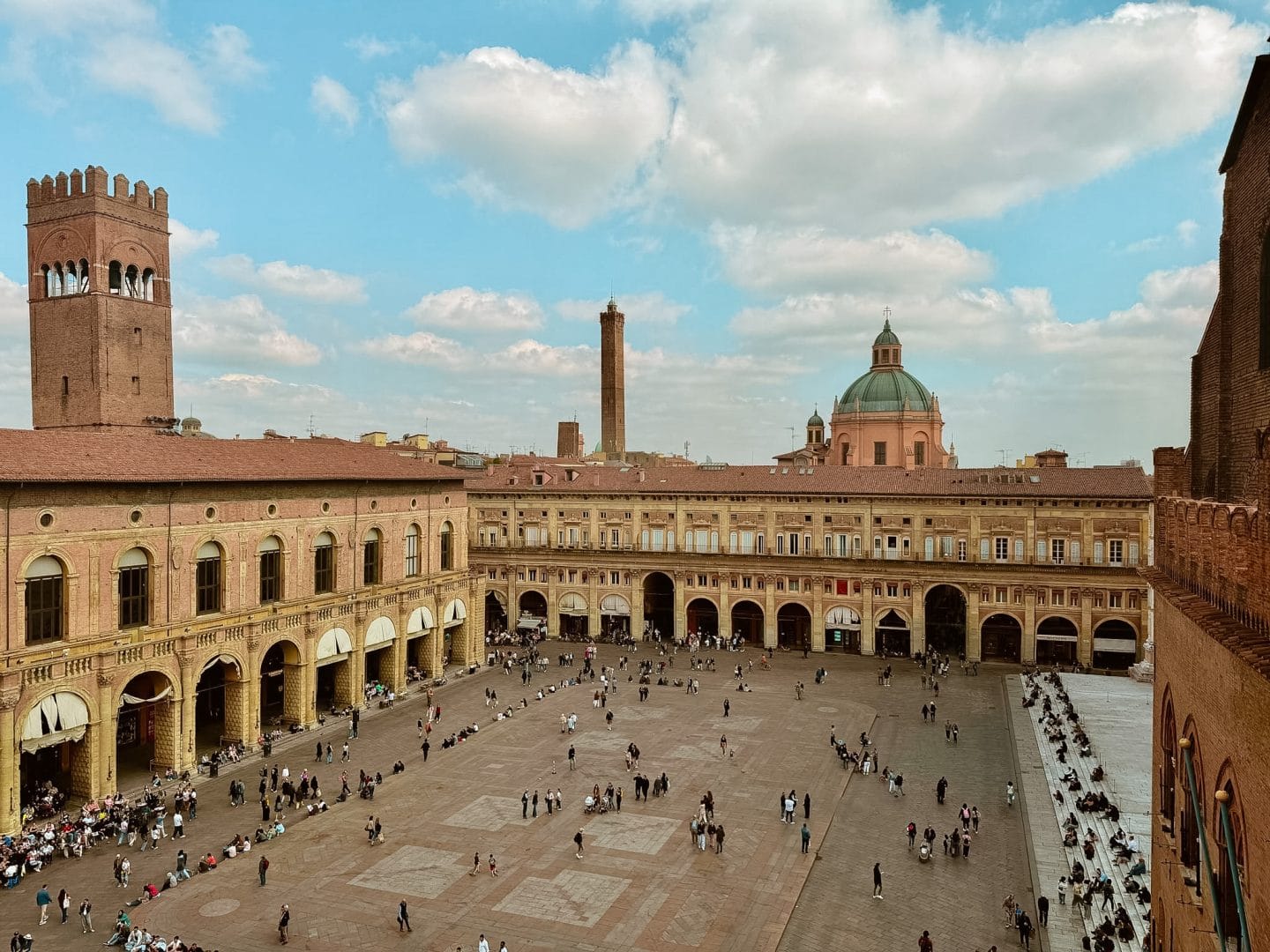
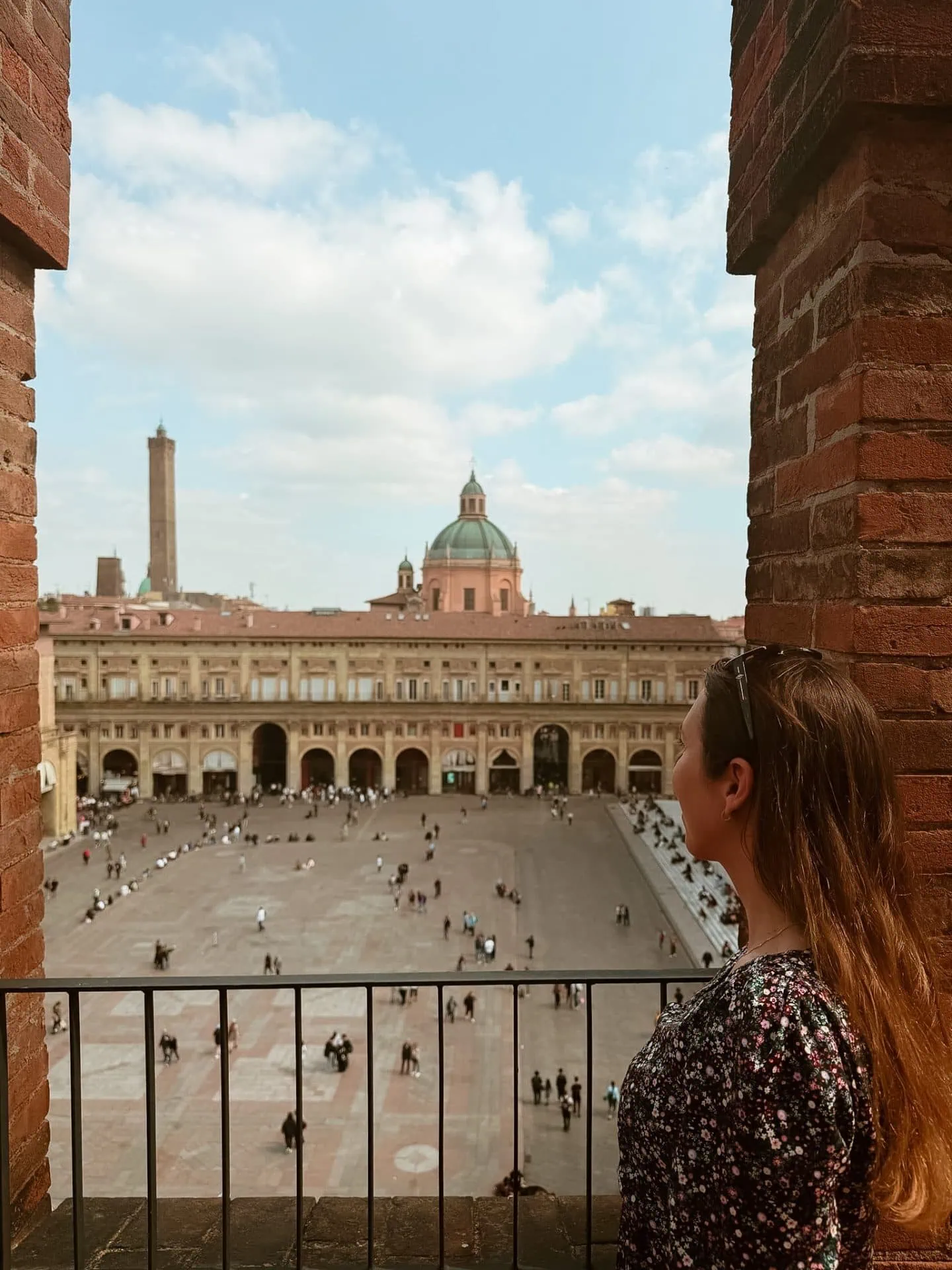
I reached Piazza Maggiore around 10:30 am. If you’re only spending one day in Bologna, this is exactly where I’d start. Piazza Maggiore and Piazza Nettuno sit side by side in the heart of the city, and within a few minutes I had already spotted several places I wanted to visit later in the day.
What surprised me most wasn’t the size of the square itself, but the scale of the Basilica di San Petronio. Photos hadn’t prepared me for it. Standing in front of it, I kept looking up, trying to take in the huge brick façade and the long arcades surrounding the square.
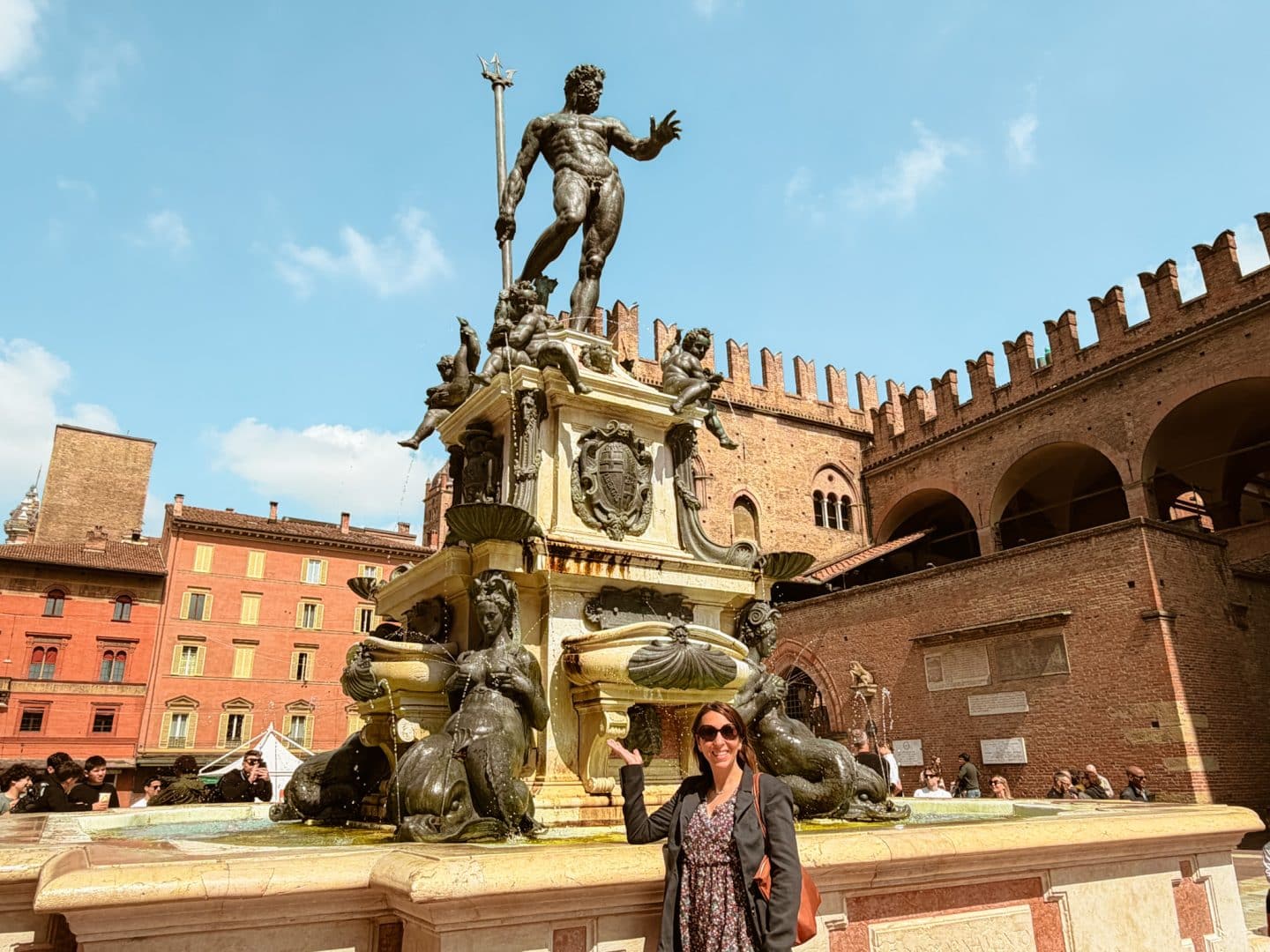
A few steps away, I found myself spending longer at the Fountain of Neptune than I expected. Not only because of the fountain itself. But also because so much of daily life seemed to pass through this corner of Bologna. Students sat along the edges, tourists stopped for photos, and locals crossed the square without paying much attention to the famous statue above them.
If I were doing this day trip again, I’d still come here first. Not because it’s Bologna’s most famous square, but because it helps you understand the layout of the city. From here, everything I visited that day was within a short walk.
Palazzo dell’Archiginnasio and it’s Teatro Anatomico
From Piazza Maggiore I walked about 5 minutes (roughly 400m) to Palazzo dell’Archiginnasio. I had originally planned to visit it later in the day after the Torre dell’Orologio, but there were no morning slots left, so I had to change plans. It actually worked out better this way, but I’ll come back to that when I talk about the Torre dell’Orologio visit.
Inside, the building immediately shows its past as the historic seat of the University of Bologna. What struck me most was the Anatomical Theatre. The entire room is carved in wood, from the walls to the ceiling, covered in intricate decorations and statues. In the centre sits Apollo, the god of medicine, watching over the space where dissections were once performed. It’s hard to reconcile the beauty of the room with the fact that this was once a place of medical study and dissection.
The theatre was almost completely destroyed during the Second World War. What you see today is a reconstruction carried out with remarkable philological precision, using original fragments recovered from the rubble of the building.
One of the world’s largest collections of heraldic decorations
One detail I didn’t expect was just how much heraldic decoration fills the rest of the palace. The walls and ceilings of the building contain what is considered one of the largest collections of mural heraldry in the world. Around 6,000 painted and carved coats of arms are displayed, belonging to former professors and students. You notice them everywhere once you start looking up, almost like a visual archive of everyone who passed through the university.
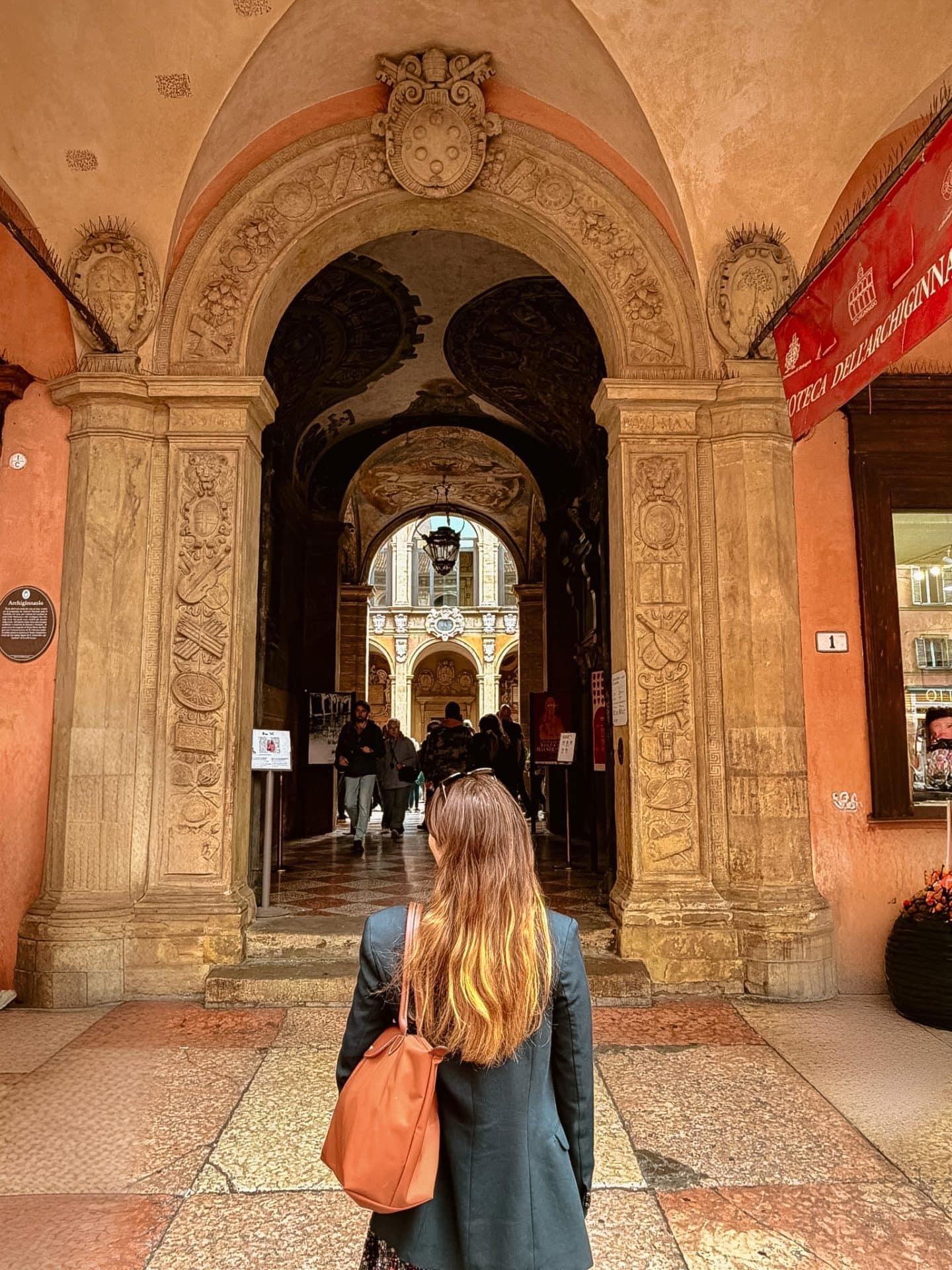
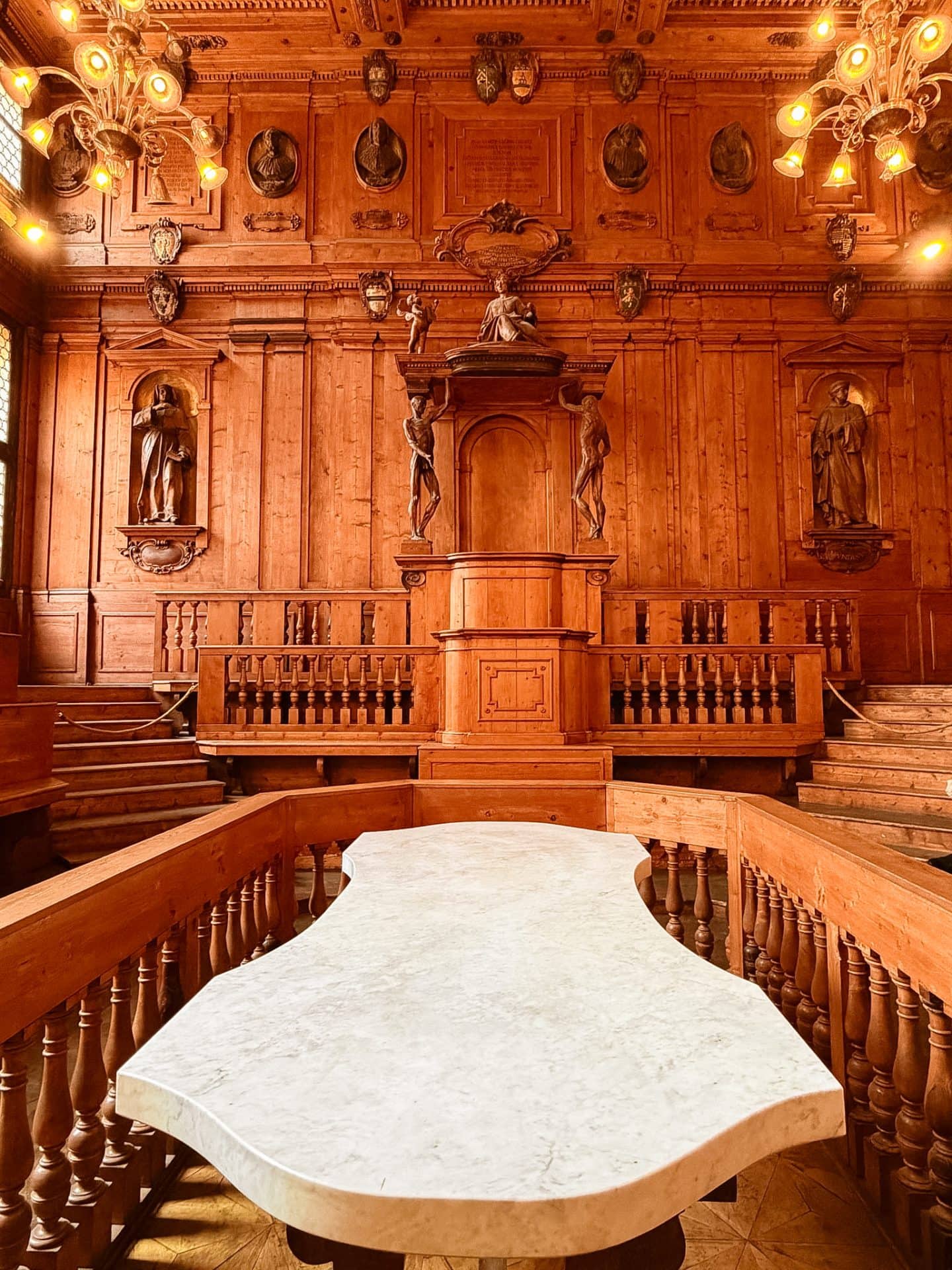
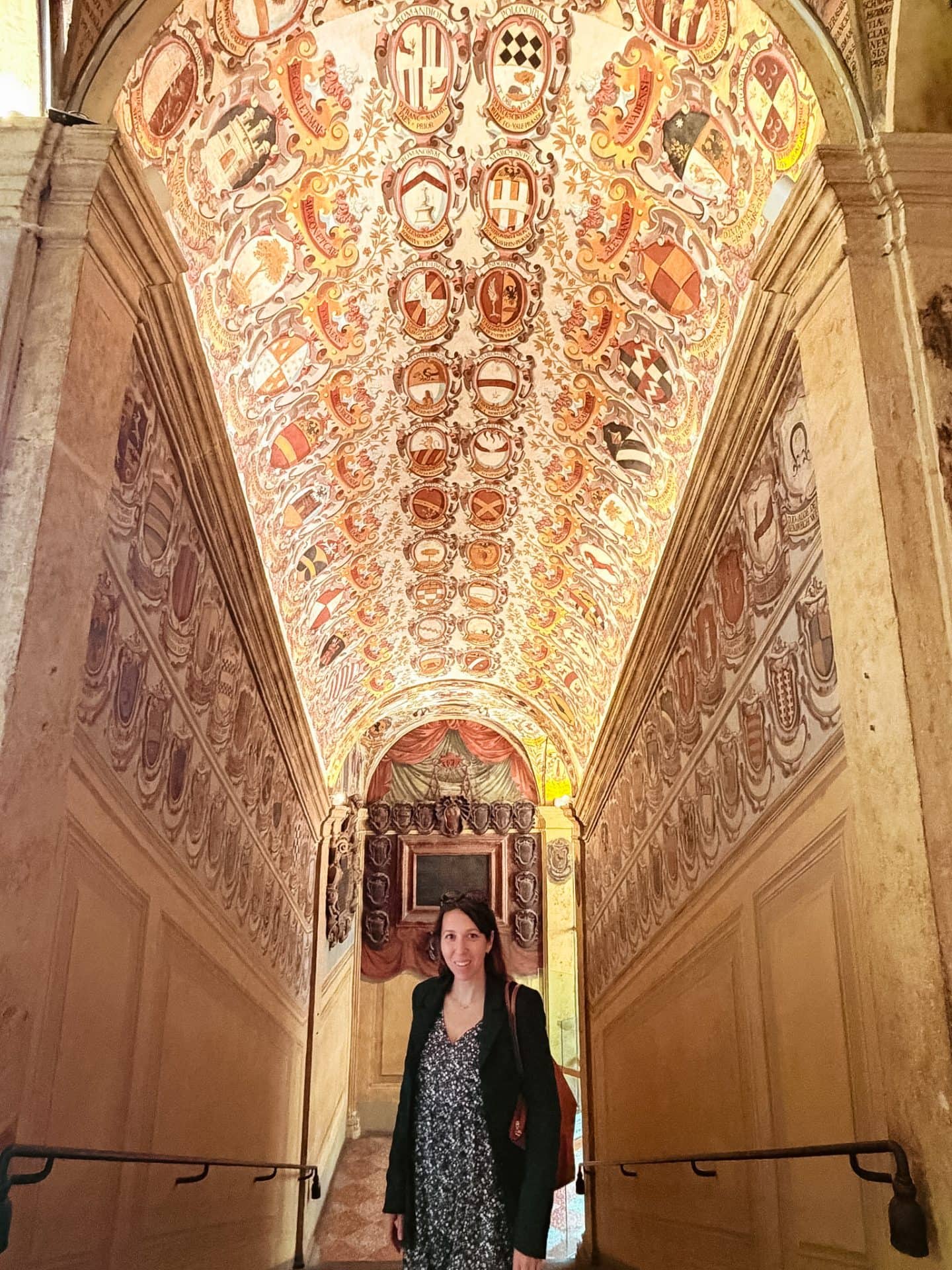
Tip: book in advance via the official tourist information website. Entry is timed (around 30 people every 10 minutes for audioguide visits), and slots fill up quickly, especially in the morning. Guided visits in Italian or English exist too, but they are more limited, so it’s worth planning ahead if you want one.
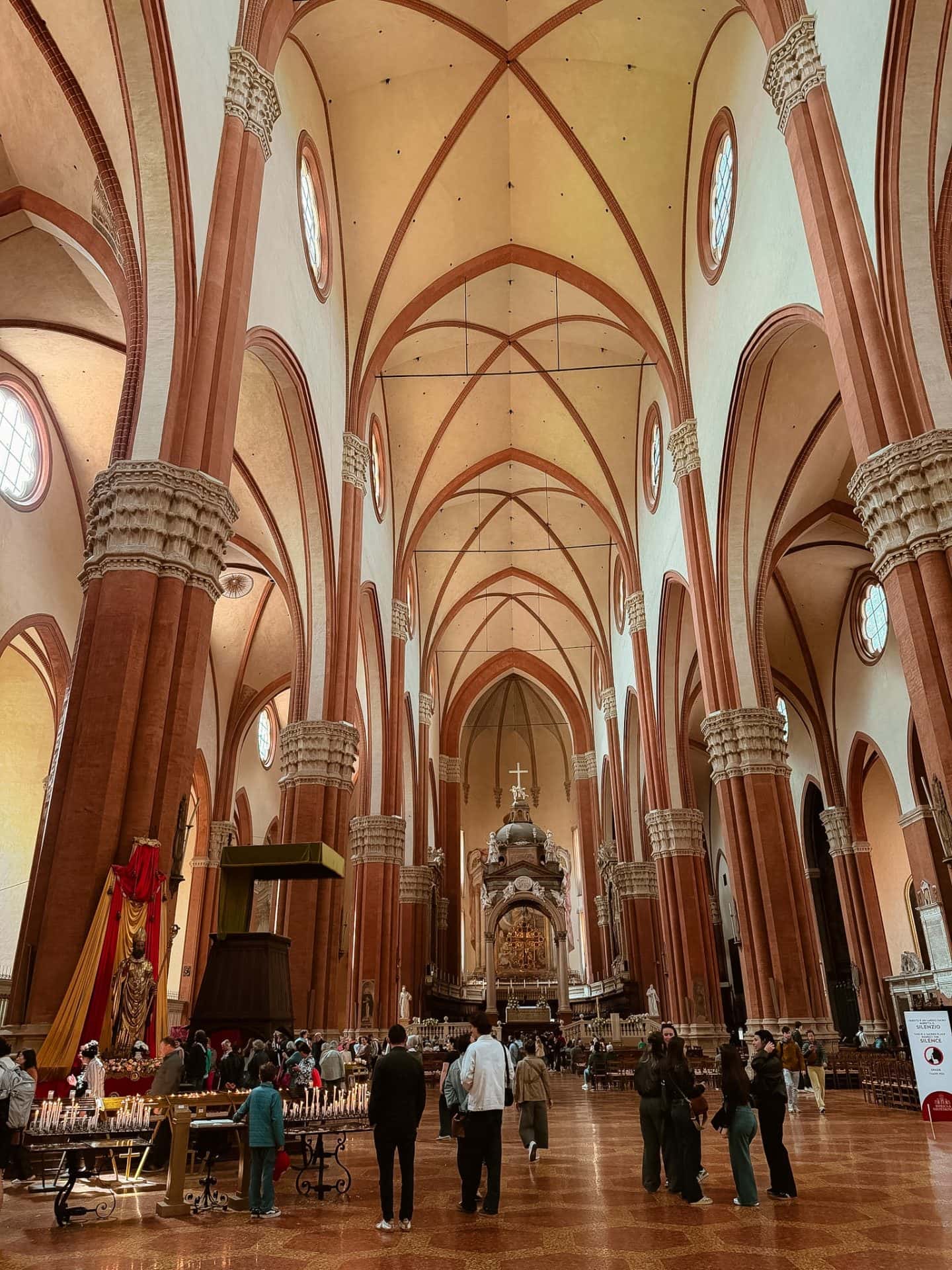
Basilica of San Petronio
After visiting Palazzo dell’Archiginnasio, I still had a bit of time before my lunch reservation. Instead of rushing, I just followed the flow of Piazza Maggiore and stepped into the Basilica of San Petronio right next door.
The change is immediate. Outside, the square feels alive and loud. Inside, everything drops into silence, cooler air, slower movement, and a completely different rhythm.
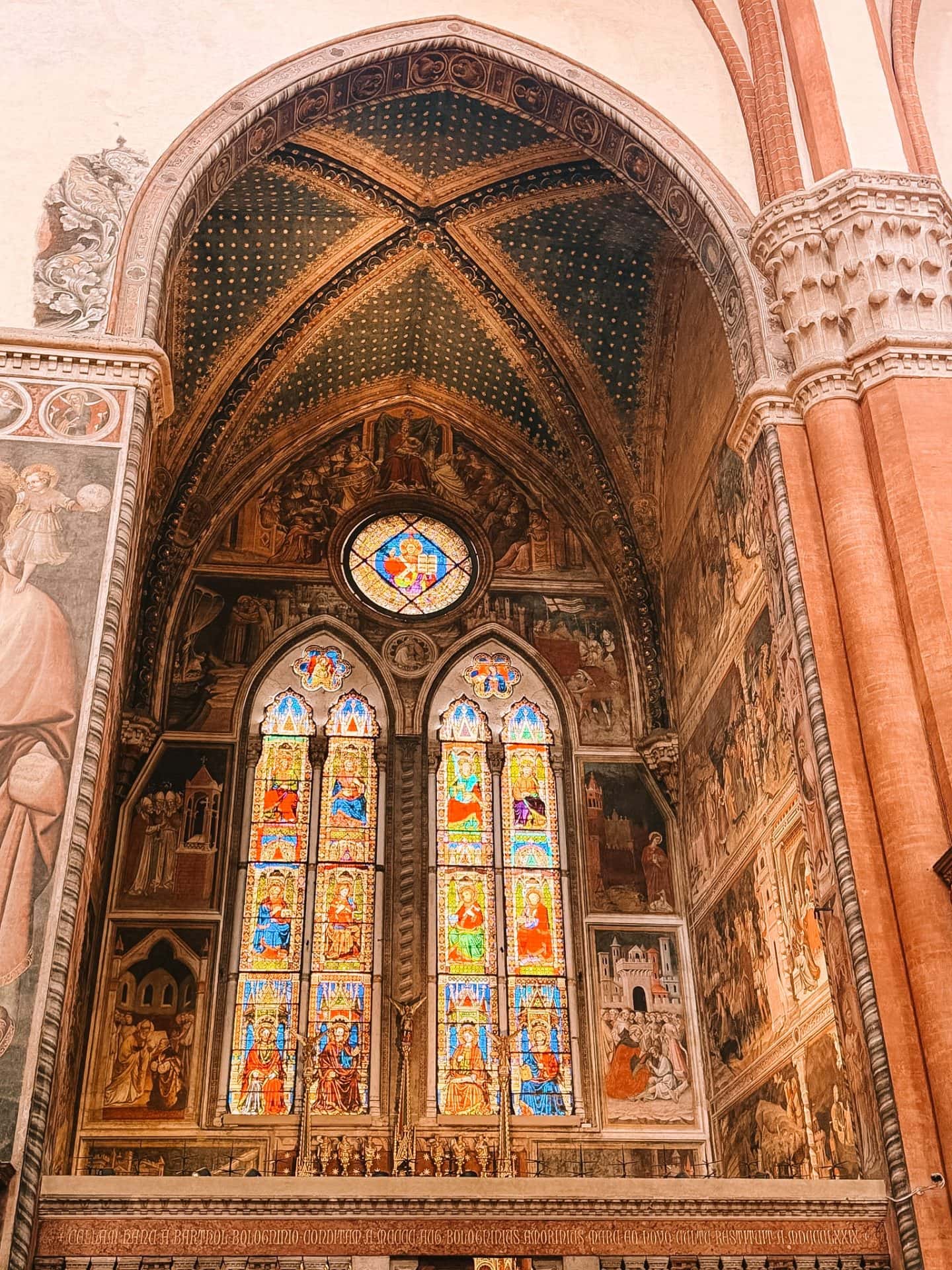
The basilica is dedicated to Saint Petronius, the patron saint of Bologna. What struck me most wasn’t the history itself, it was the atmosphere. Places like this always create a strange sense of calm as if the space itself forces you to slow down.
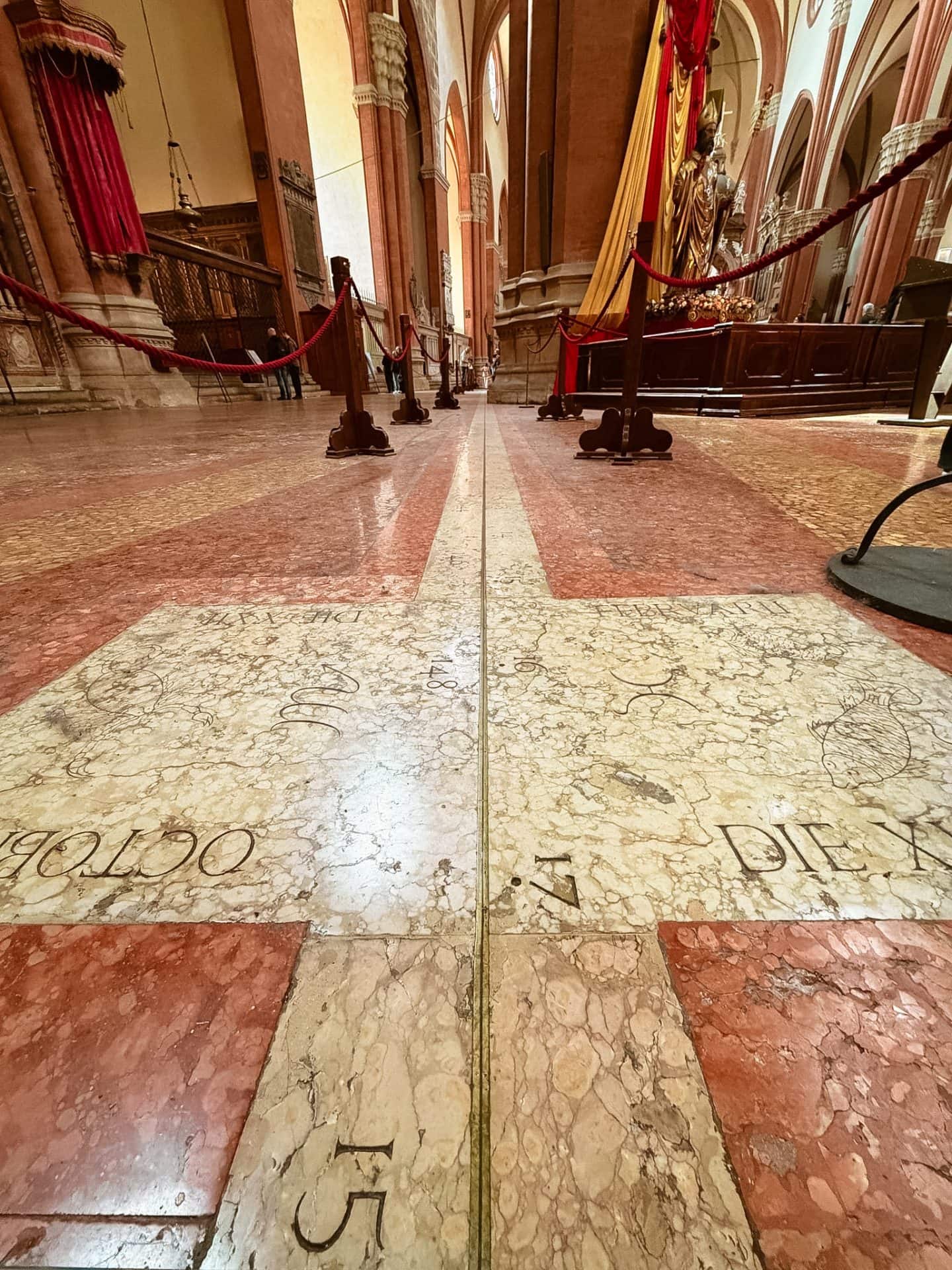
The scale is what really stays with you. It’s one of the largest brick churches in the world, and it somehow feels both massive and intimate at the same time. The light coming through the stained glass, the worn stone underfoot, the frescoes fading into the walls. But the detail that captivated me the most was on the floor.
The sundial meridian line: where science meets architecture
Running across the basilica floor is a 66-metre meridian line, designed in 1655 by the astronomer Giovanni Domenico Cassini. At first, it just looks like a brass line embedded in stone. But once you understand it, the whole room changes meaning. A small opening high up in the wall lets a beam of sunlight enter the church. At solar noon, that light lands precisely on the line, and as the seasons move, its position slowly shifts along it.
With this system, astronomers were able to: measure the exact length of the solar year, track the sun’s movement through the seasons and check the accuracy of the calendar
Standing there and watching that thin line of light move across the floor, I realised how naturally this place blends science, architecture, and something almost spiritual. It’s not the kind of detail you notice straight away. But once you do, it becomes one of the strongest memories of the visit.
You don’t need to buy a ticket for the Basilica of San Petronio, entrance is free.
Lunch break during my day in Bologna
By the time late morning turned into early afternoon, it was time for what is, in Italy, never just a break, lunch or in Italian ‘collazione’. Before my trip, my Italian teacher Giuseppe who lives in Bologna had shared a list of his favourite addresses in the city centre. The kind of places you don’t always find on Google.
His recommendations: Leonida, Cantina Bentivoglio, Trattoria il Rosso, Twin Side and Trattoria del Tempo Buono.
I have to admit, I was hoping to find one of those very traditional osterias, with an old interior, a slightly worn décor, and that unmistakable feeling of stepping into a place that hasn’t changed in years. The kind of restaurant where locals linger over long lunches and Italian nonne (grandmothers) are behind the stove. In Bologna, many places have adapted to tourism, and that exact atmosphere is sometimes harder to find in the historic centre.
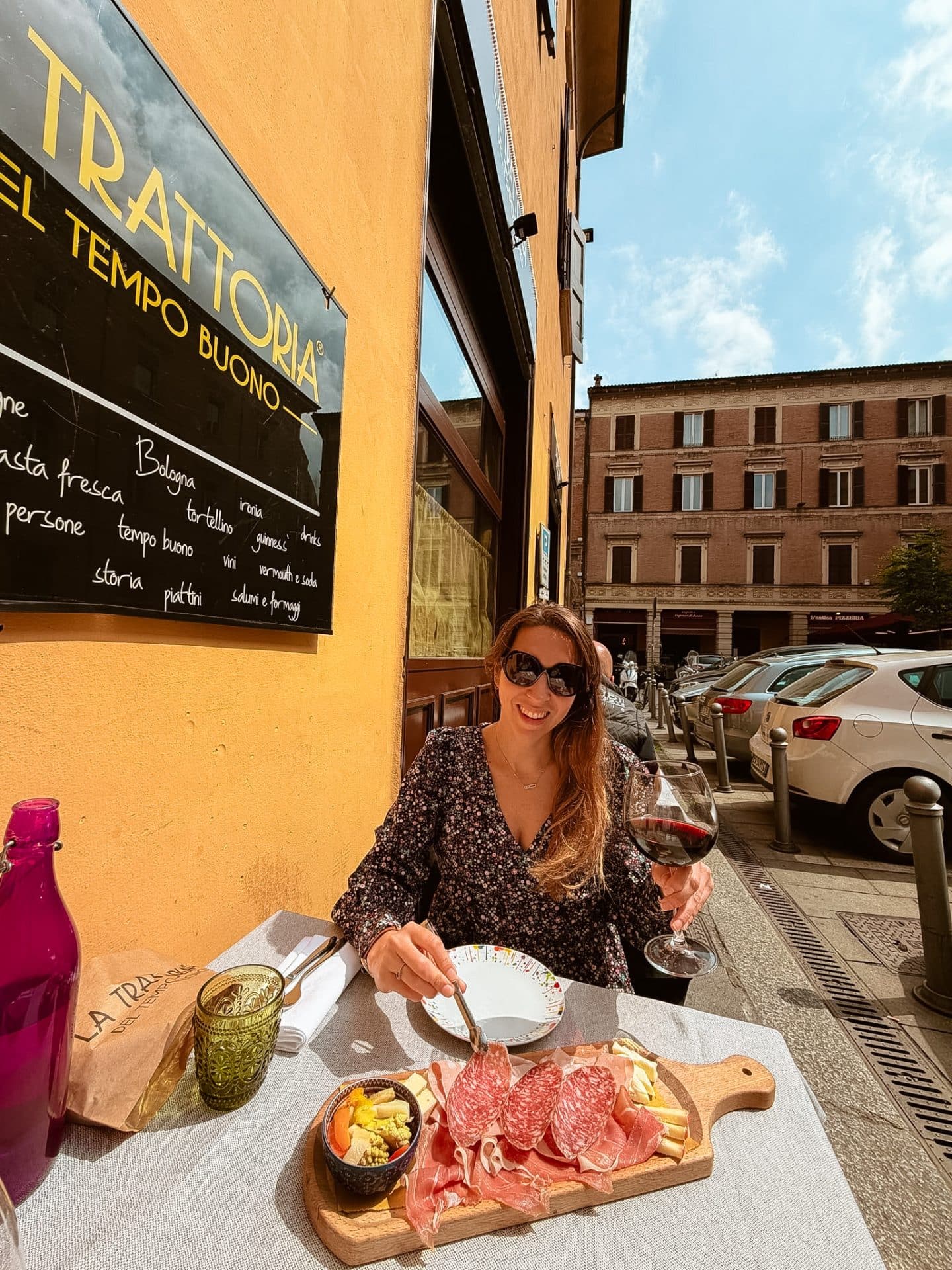
Trattoria del Tempo Buono
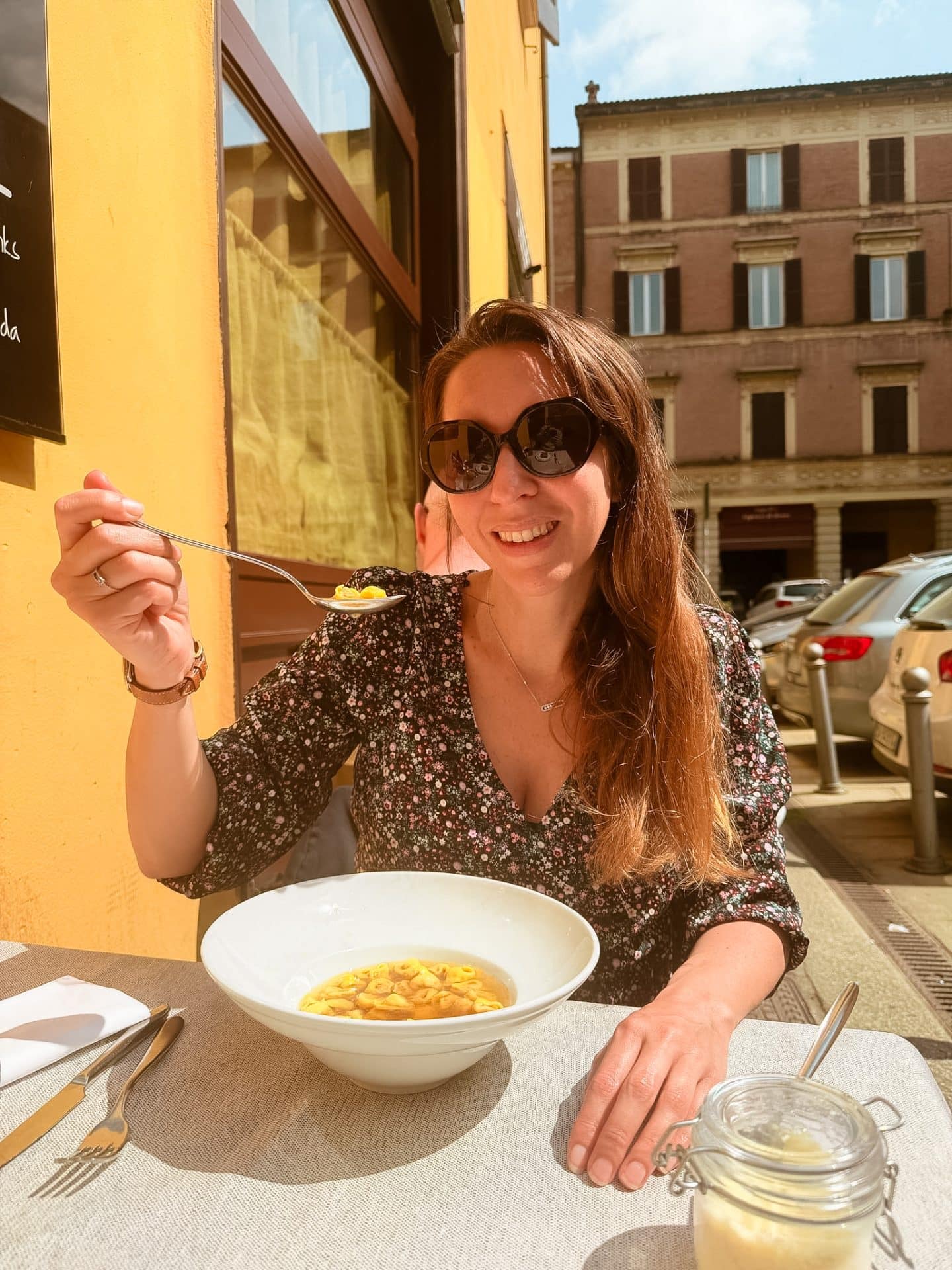
Less than a 10-minute walk from Piazza Maggiore, this trattoria sits slightly away from the busiest streets. I chose a table outside. There’s a small covered terrace, as well as a few tables placed directly against the façade. I ended up in the sun, which, in early April, already felt surprisingly strong.
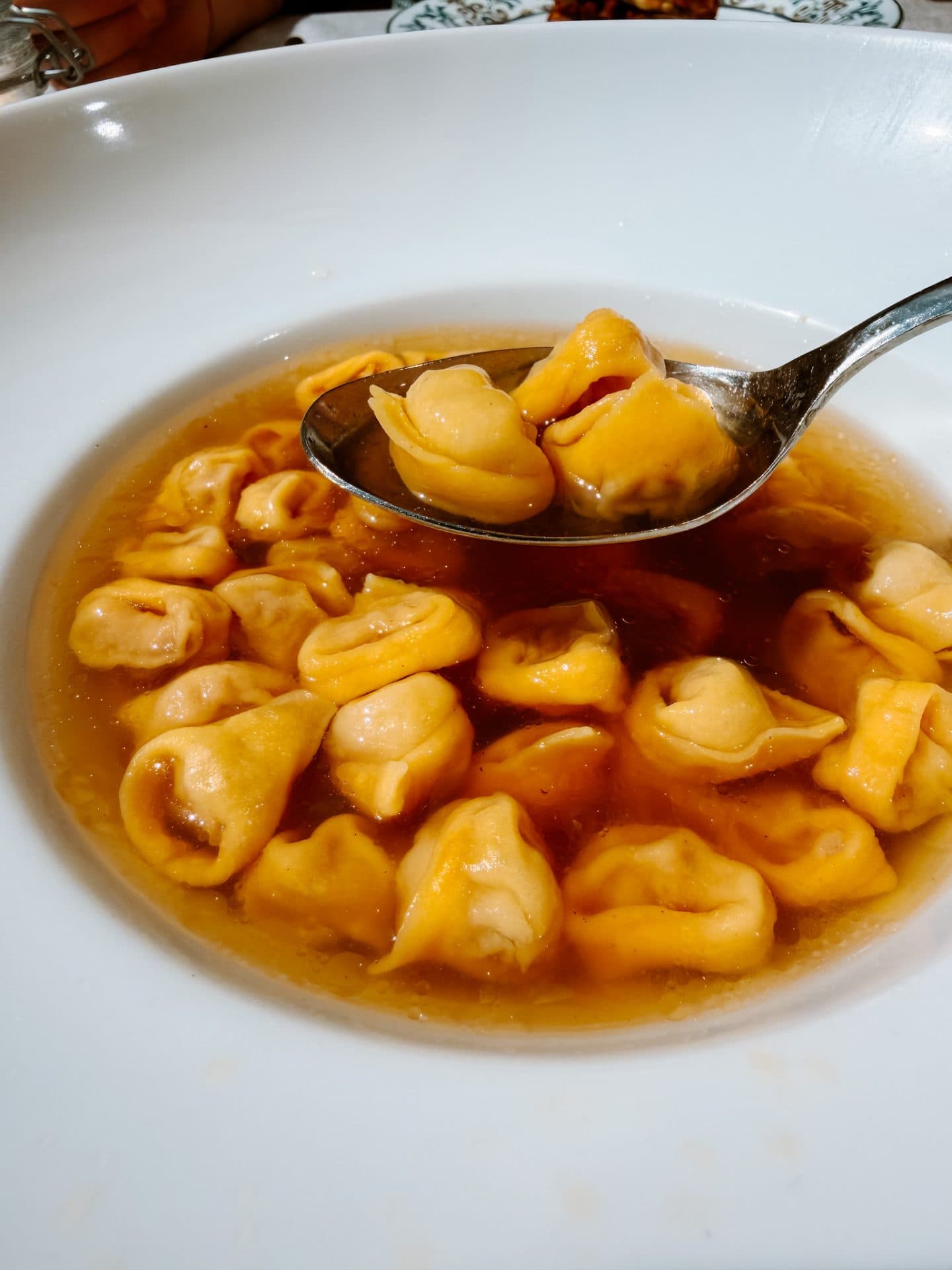
I decided to try two local specialities. First, a delicious charcuterie board with mortadella, the famous delicately flavoured sausage that originates from Bologna itself. And then, tortellini in brodo, small stuffed pasta served in a clear, flavourful broth. It’s a very traditional dish, simple but comforting, with a depth of flavour that comes from the broth rather than heavy sauces. I really enjoyed it, but I have to say, it feels like a dish made for colder days.
Sitting there, with a glass of wine, the soft noise of the street around me, and nowhere else to be, I realised once again that in Italy, lunch is part of the experience.
Tip: if you’re booking, ask for a table under the covered terrace. Even in spring, the sun can be intense, and in summer, I can imagine it becoming quite overwhelming at lunchtime.
Torre dell’Orologio (clock tower) and Palazzo d’Accursio (town hall)
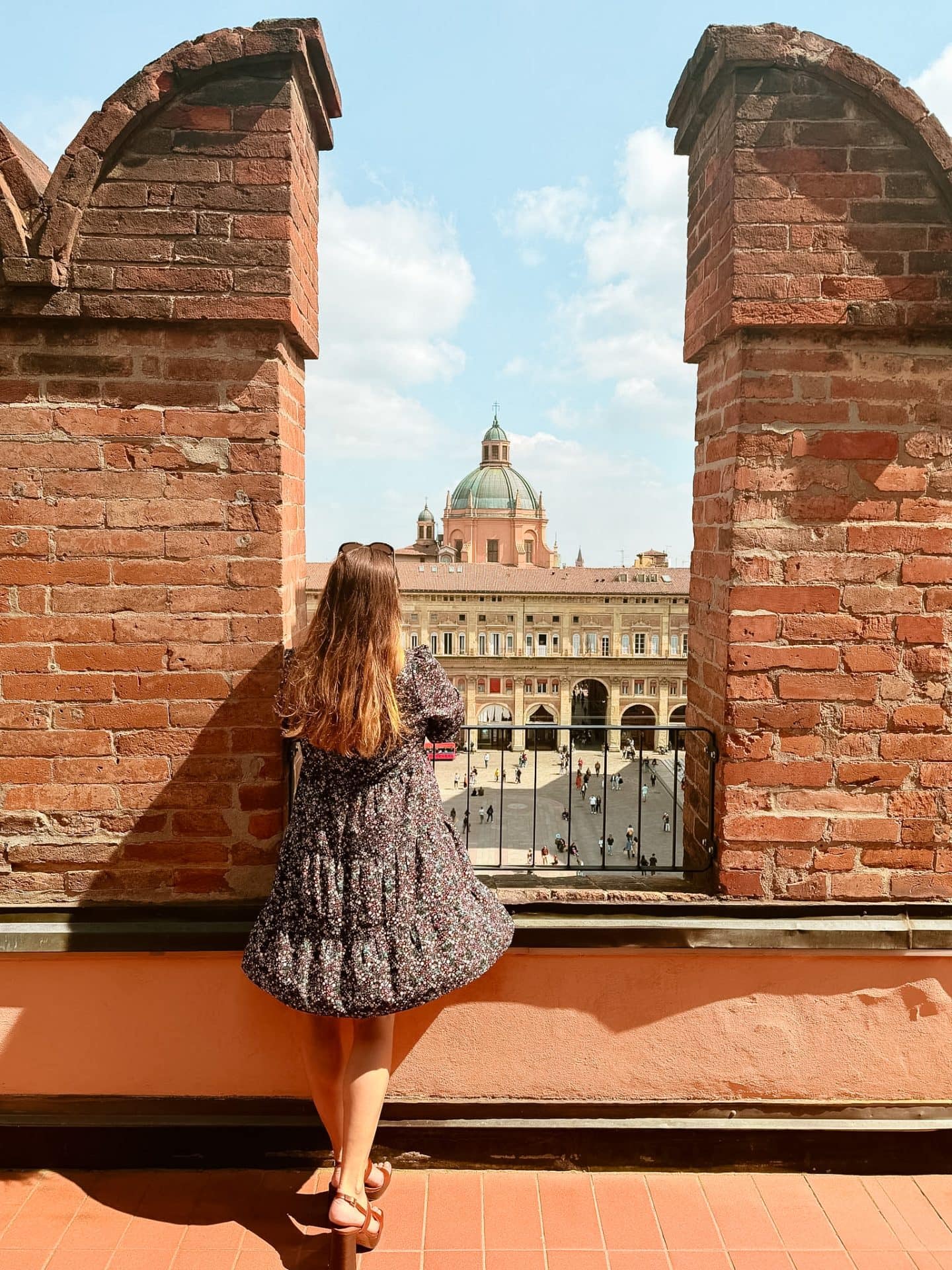
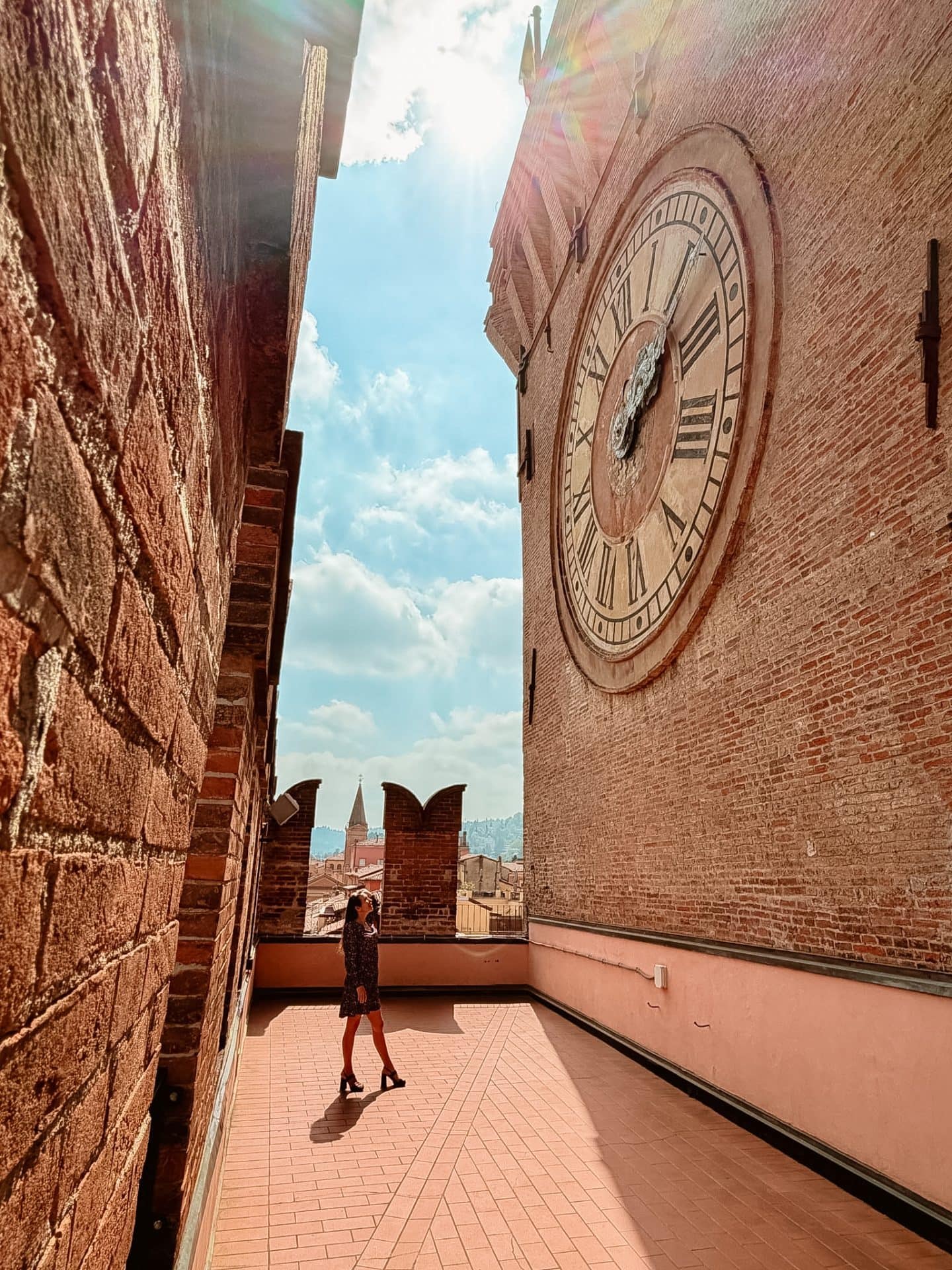
From Piazza Maggiore I went inside the Torre dell’Orologio (clock tower) in Bologna, part of Palazzo d’Accursio, for a visit that also includes the Municipal Art Collections. The visit lasts about 40 minutes for the tower and roughly 1 hour for the collections, depending on how slowly you move through the rooms.
At the entrance, I scanned a QR code and immediately had the audioguide on my phone. It was available in Italian, English, Spanish, and French, and it became the main way to follow the visit once inside.
I had originally planned to start my day with the Torre dell’Orologio, but there were no available slots in the morning, so I reshuffled my planning and began instead with Palazzo dell’Archiginnasio. I only managed to visit the clock tower at the very end of the day, and in hindsight, that change of order turned out to be the best possible version of the visit.
A rooftop view that connects the whole of Bologna
After having spent the entire day walking through Bologna, the Torre dell’Orologio didn’t feel like just another stop. From the rooftop, I could actually recognise the places I had visited earlier. Piazza Maggiore, the surrounding streets, the rooftops of the historic centre, all falling into place like a map I had slowly built throughout the day.
It gave the whole visit a different perspective. Instead of starting with a view and then trying to understand the city, I ended the day with a view that made everything I had seen earlier suddenly make sense.
Tip: What matters most here is timing. Entry is strictly limited to small groups: 15 people every 20 minutes, so the whole experience is shaped by the slot you manage to book. I booked in advance through the official Bologna tourism site, and I’d strongly recommend doing the same, especially if you want a specific time in the morning or early afternoon. Without a reservation, there’s a real chance you simply won’t get in at a time that fits your day.
Biblioteca Salaborsa
When I came out of the Torre dell’Orologio and Palazzo d’Accursio, I naturally ended up back in Piazza Maggiore. On my way towards the station, I passed in front of Biblioteca Salaborsa, just beside Piazza Nettuno. I hadn’t planned to visit it at all. Curiosity simply got the better of me, so I stepped inside for a quick look.
And that’s exactly why I’d recommend doing the same. You don’t need to set aside an hour for it or build your day around it. Just walk in if you’re already nearby.
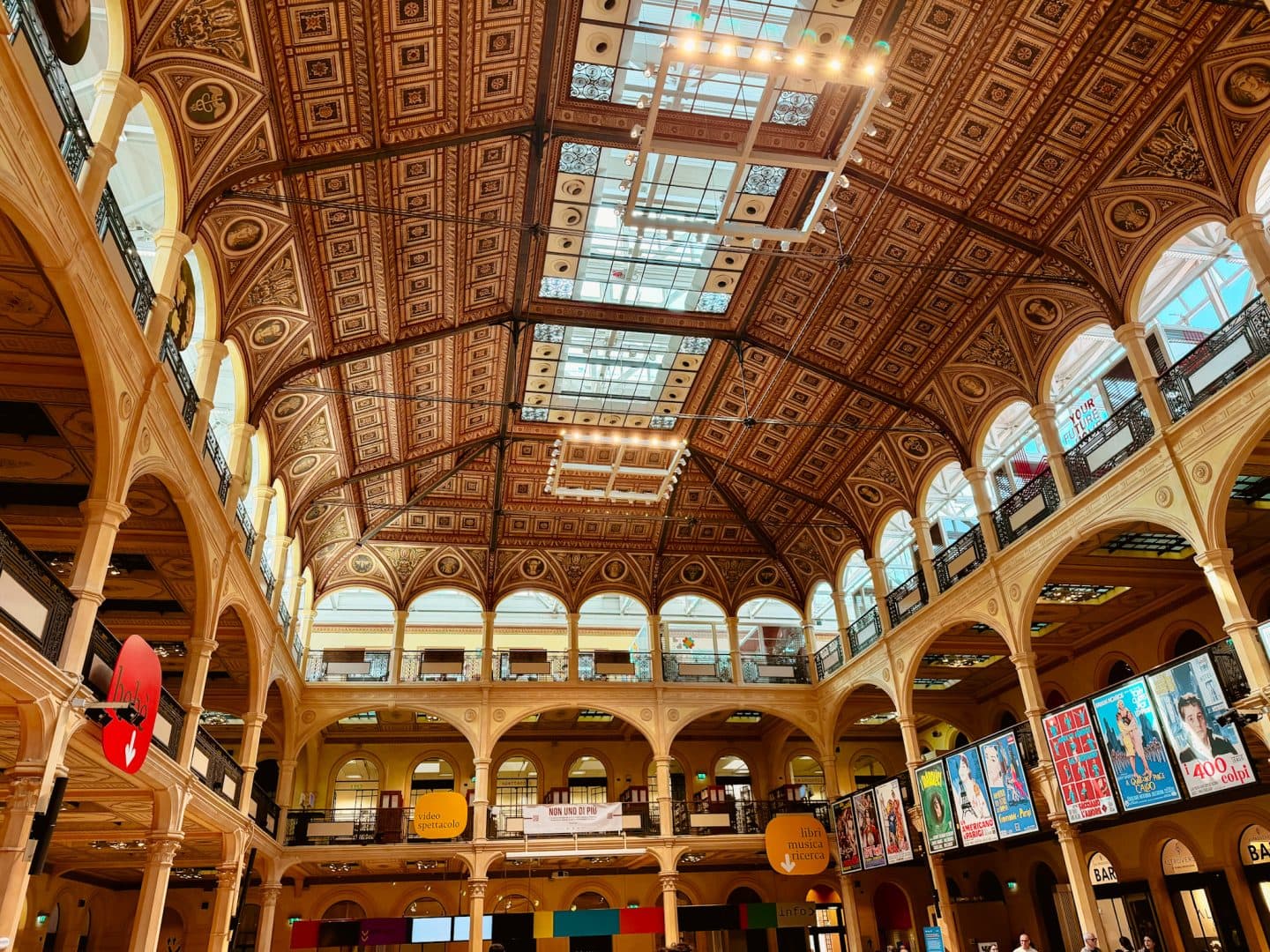
The first thing that caught my attention was the huge iron-and-glass roof above the central hall. Built in the early 1900s, it transformed what had once been a convent into a modern public space. But the real surprise is under your feet.
In the middle of the library, a transparent floor allows you to look directly down onto the archaeological remains of ancient Roman Bononia. Standing there, I found myself looking through centuries of Bologna’s history layered beneath the building. It’s one of those details that’s easy to miss if you’re rushing through the city, but it perfectly captures what I enjoyed most about Bologna: history constantly appearing where you least expect it.
One place I should have skipped during my day trip to Bologna
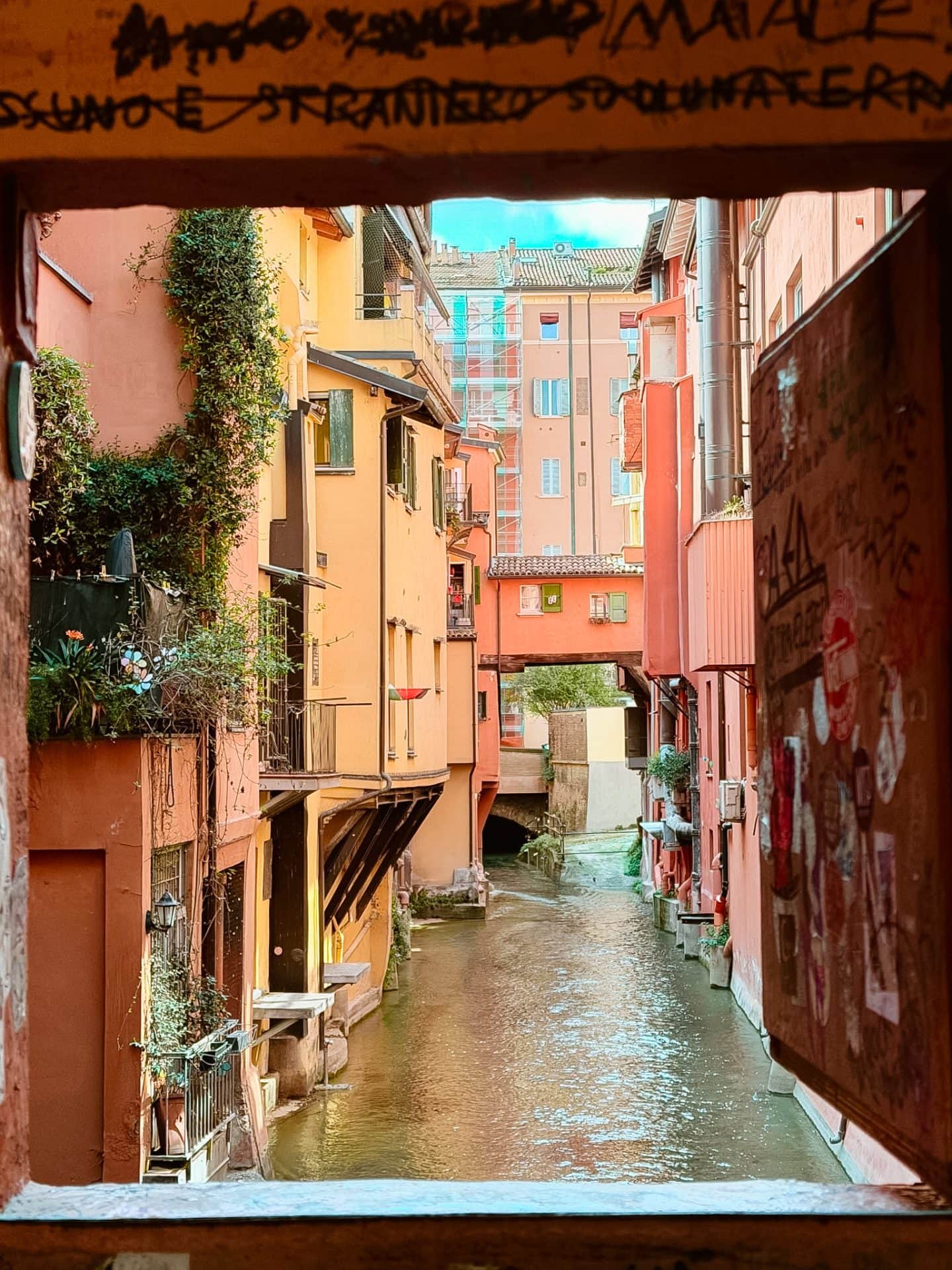
After lunch, I decided to walk over to the Finestrella di Via Piella. It’s a little farther from the historic centre than most of the places, but it appears in almost every list of things to do in Bologna. I was curious to see whether it was worth the detour. It wasn’t.
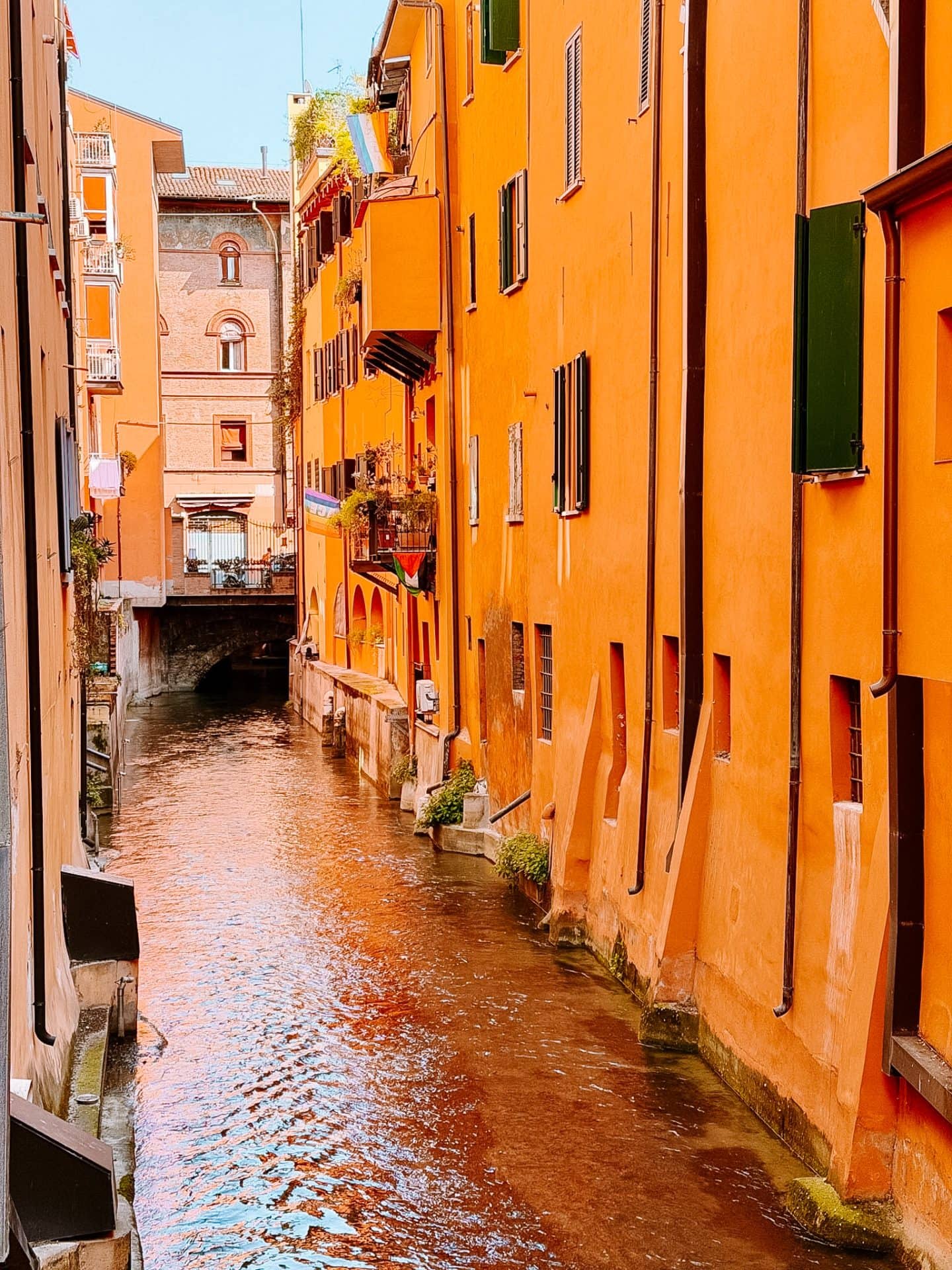
The attraction is essentially a small window overlooking a section of the old canal. In photos, especially when tightly framed, it looks like a hidden corner of Venice tucked away in Bologna. The reality is much less impressive. And the craziest part was the queue, a long line of people waiting just to take a photo or a video.
If you happen to walk past it, have a look. Or even better, go to the other side of the street where you can see the old canal directly, without looking through a window and without having to queue.
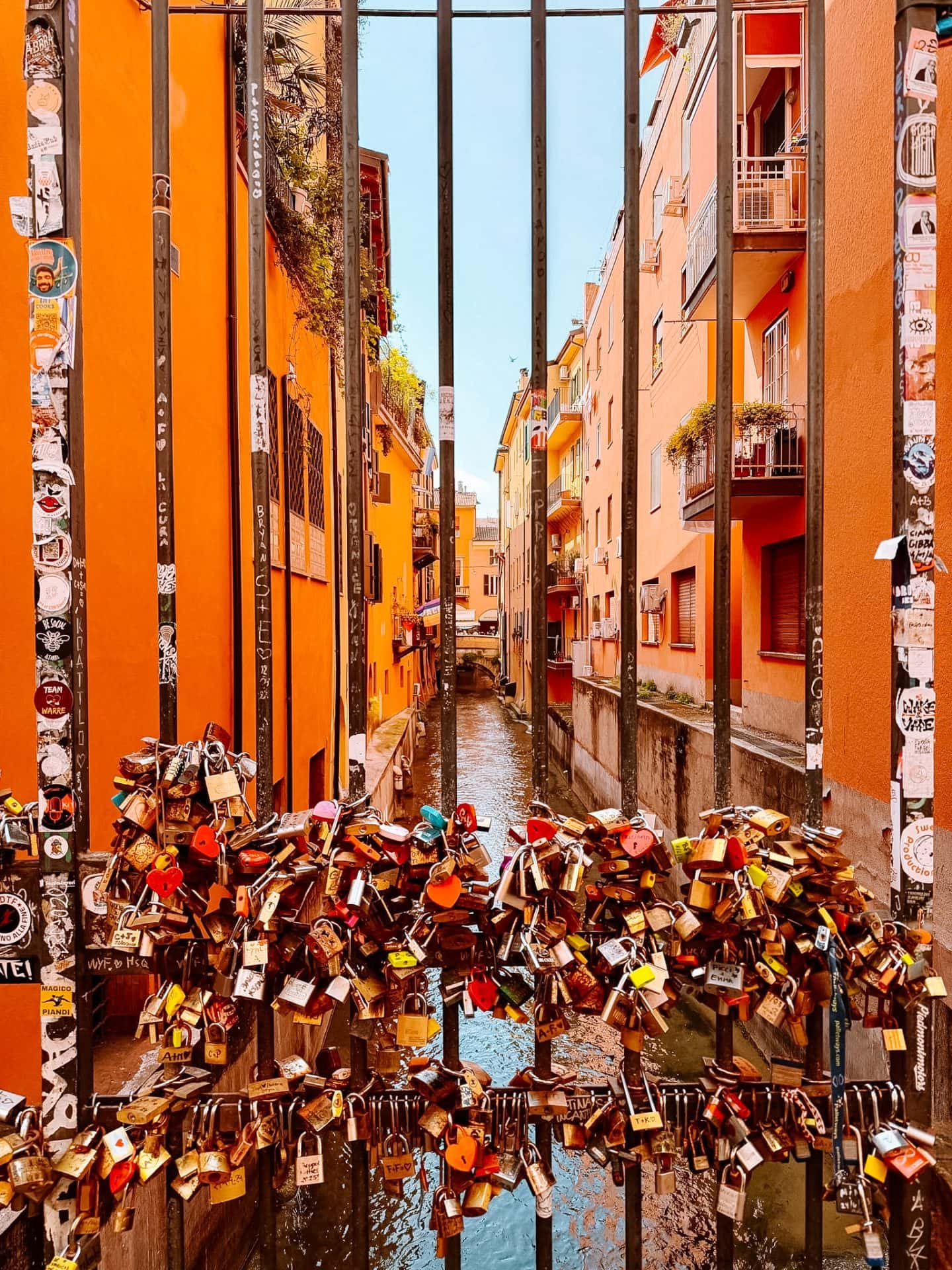
If you’re only spending one day in Bologna, I wouldn’t leave the historic centre or waste time waiting for it. For me, the Finestrella di Via Piella is completely overrated.
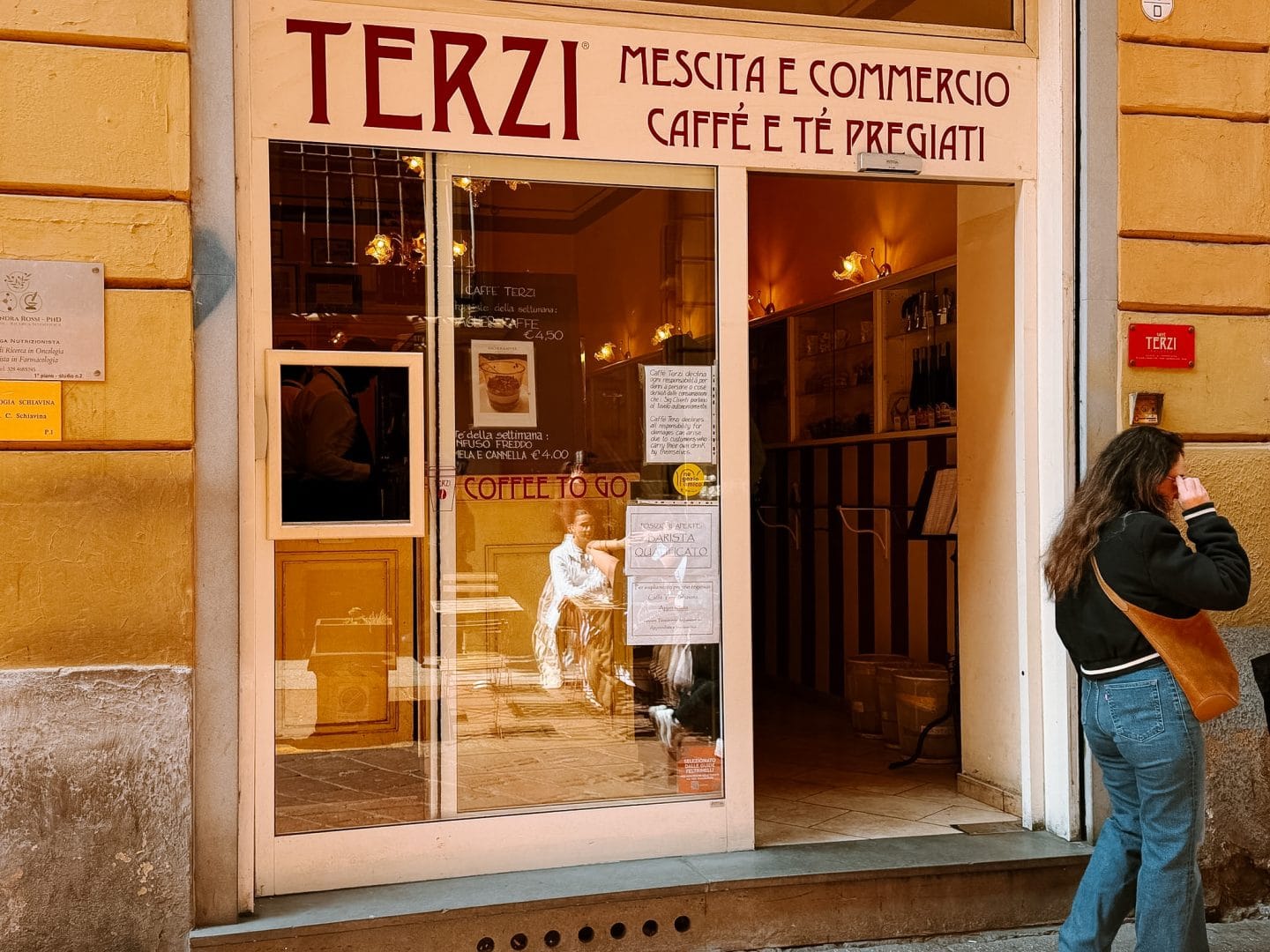
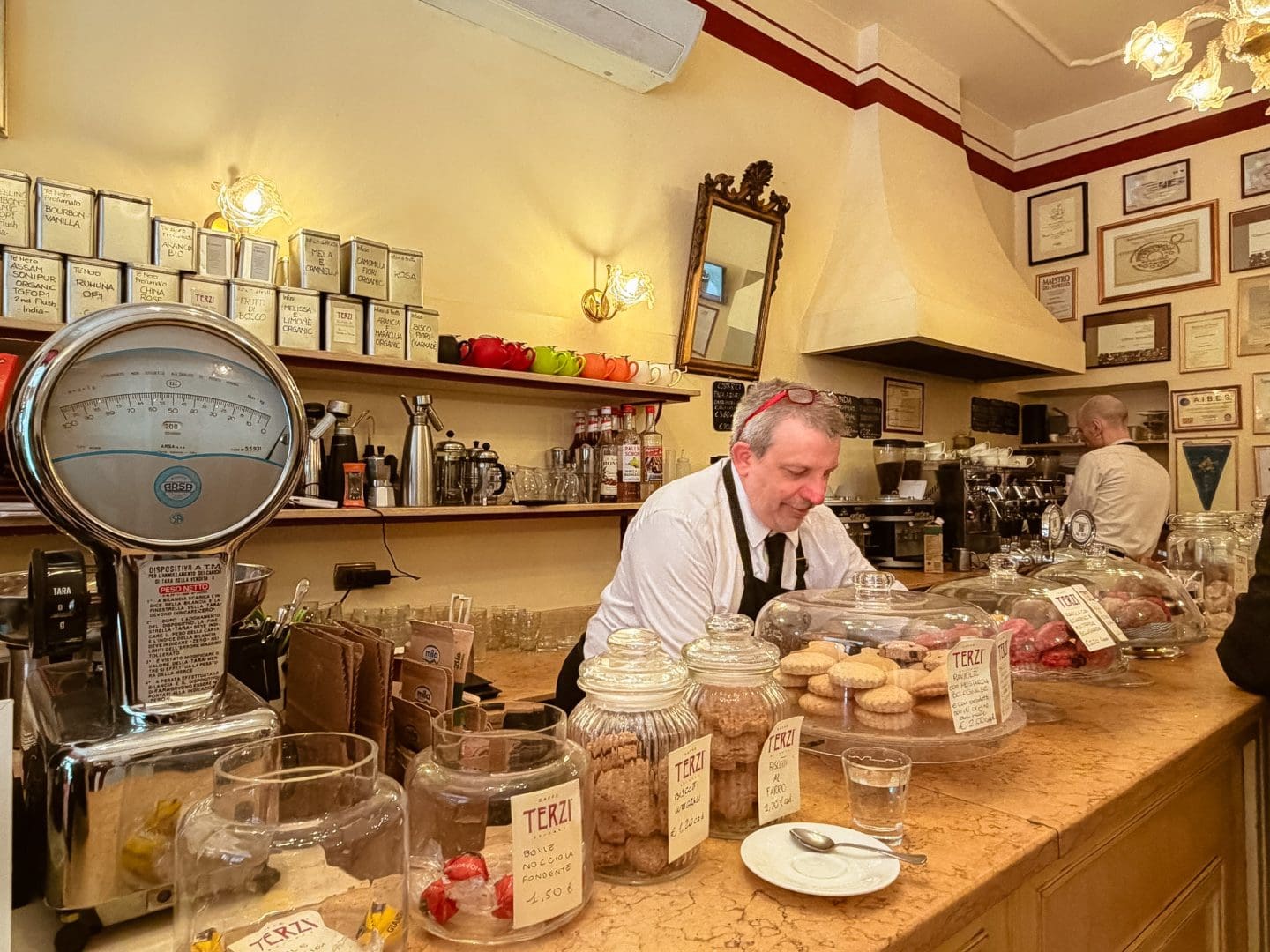
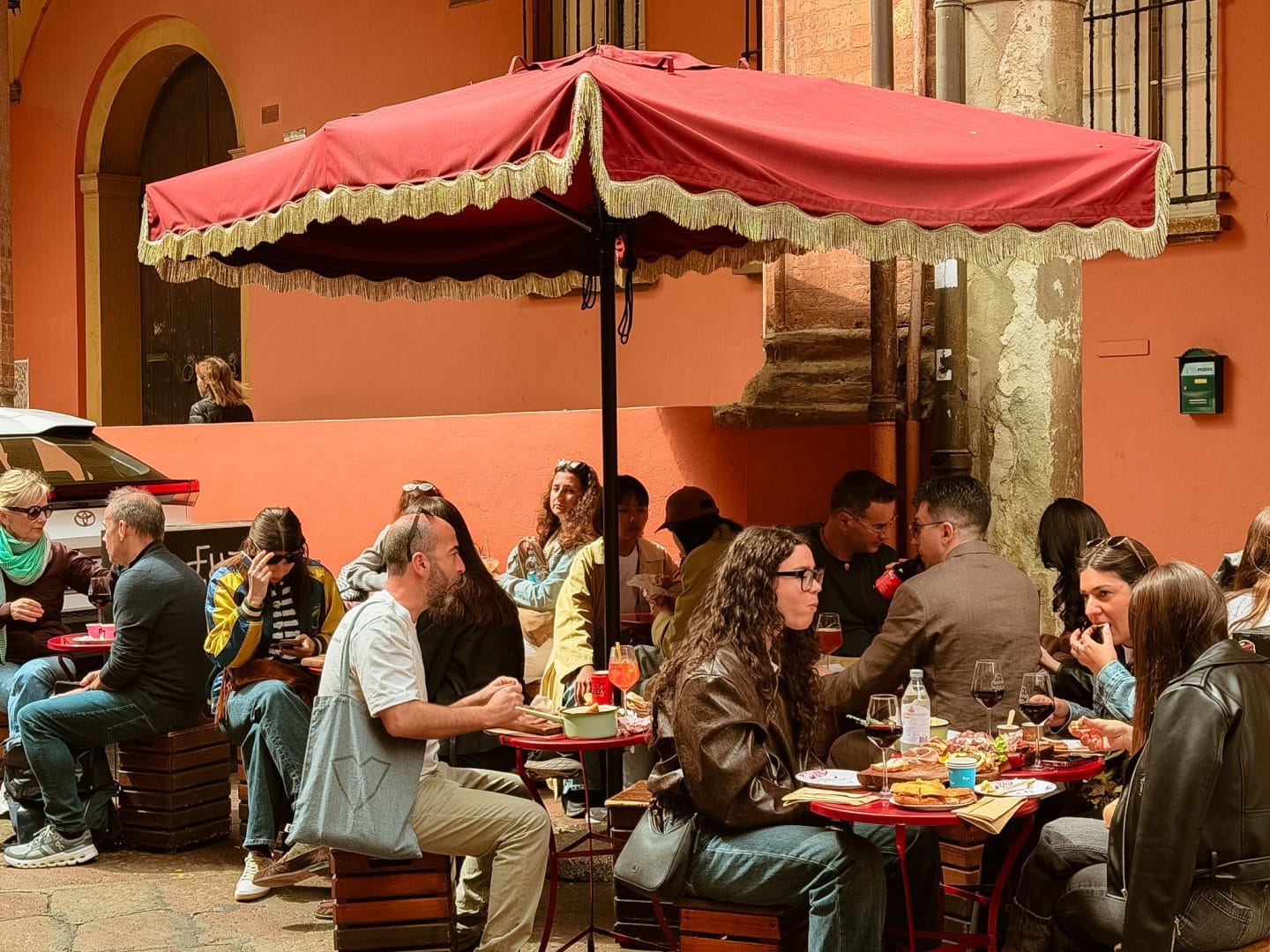
But in the end, the visit wasn’t all wasted time. I found two places that made it worth it: a very small, tucked-away coffee shop called Terzi, perfect for an authentic Italian coffee (you can even order through a little window), and another spot if you want a quick lunch: La Prosciutteria, with panini, wine, and a real Italian street-side atmosphere.
My day trip from Florence to Bologna in Italy by train
When I boarded the 9:25am train from Florence that morning, I wasn’t entirely sure what to expect from Bologna. Less than 40 minutes later, I found myself in a city that felt noticeably different from Florence: less crowded, less intense, and somehow easier to enjoy at a slower pace.
What surprised me most is how much I managed to see in a single day without ever feeling rushed. Between the Archiginnasio, the Basilica of San Petronio, Piazza Maggiore, the Torre dell’Orologio and a few unexpected stops along the way, Bologna proved to be one of the easiest day trips I’ve taken in Italy.
If there’s one thing I’d do exactly the same, it’s ending the day at the Torre dell’Orologio rather than starting there. Looking out across the rooftops after spending hours exploring the city below made everything click into place.
If there’s one thing I’d skip, it’s the Finestrella di Via Piella. I know it’s one of Bologna’s most photographed spots, but in reality it’s a tiny window overlooking a canal that you can see perfectly well without joining a queue. Spending 20 minutes waiting in line for a three-second Instagram video simply isn’t the best use of a one-day itinerary.
A slow-paced city that’s perfect for a one-day exploration
So, is Bologna worth a day trip from Florence? Absolutely. Just be selective, book your key visits in advance, and leave enough room in your schedule for the small surprises that don’t appear on any checklist.
If you’re planning a trip to Tuscany in Italy, I’d definitely recommend staying in Florence and using it as a base for day trips around the region. If you’re looking for ideas, you can read my guide to the best day trips from Florence by train for easy escapes from the city. Take at least two days to explore Florence itself. My 2-day Florence itinerary covers exactly what to do, where to go, what to see, and what to eat. Basically how I would spend a long weekend there. And if you’re looking for somewhere exceptional to stay in Florence have a look at my guide to the best luxury hotels in Florence, where I’ve selected the properties that combine location, character, and memorable views over the city.
FAQ day trip Bologna from Florence | Italy
Yes, Bologna is one of the easiest and most rewarding day trips from Florence. The high-speed train takes under 40 minutes, and the historic centre is compact enough to explore on foot in a single day.
The high-speed train from Florence to Bologna takes around 40 minutes. Trains run frequently throughout the day from Firenze Santa Maria Novella station.
The best time is between 8:00 and 9:30 am. Arriving in Bologna before 10:00 am gives you a full day in the city without rushing and allows time for both museum visits and a relaxed lunch.
Prices vary depending on how early you book. On average, expect around €15–€25 if booked in advance. Last-minute tickets can go up to €50–€60 for the same seat, especially during peak travel days.
Yes. Bologna Centrale is about a 15–20 minute walk from the historic centre. It’s an easy and pleasant walk that naturally leads you into Piazza Maggiore.
Yes, Bologna is ideal for a one-day visit if you stay in the historic centre. Most major sights, including Piazza Maggiore, the Archiginnasio, and the Basilica of San Petronio, are within walking distance.
Official tourism website: www.bolognawelcome.com
Yes, for key sites like the Torre dell’Orologio or Palazzo dell’Archiginnasio visits, booking in advance is strongly recommended. Entry is often limited to small groups with timed slots, especially during weekends and holidays.
The best and most reliable way to book tickets for attractions in Bologna is through the official tourism platform Bologna Welcome. Here you’re ensured to get official pricing with no hidden fees, secure and verified tickets, access to guided tours and museum passes and up-to-date availability and seasonal experiences.
Not really. The Finestrella di Via Piella is a small canal window that often has a queue but offers a very limited view. It’s one of the most overrated spots in Bologna, and not worth spending time on during a one-day itinerary.
Explore more related articles about Tuscany and Italy:
- Florence in 2 Days: the best things to see, eat & experience on foot
- Day Trips from Florence: My 7 curated Tuscan escapes by train
- My ultimate luxury guide to 17 exceptional stays in 5 star hotels in Florence
- Castelfalfi Tuscany Resort: the ultimate getaway in Italy
- Discover other Italian destinations
- Florence: 7 hidden boutique spots away from the tourist crowds
- Looking for more inspiration for slow travel destinations? Explore our slow travel section.

Meet Jessika, a luxury travel writer with a background in international hospitality spanning over 15 years. Half Dutch, half French, and fluent in five languages, she has a natural affinity for the finer things: elegant hotels with soul, wine regions with a story to tell, and tables that celebrate local flavour at its best. Her writing is shaped by a slow, intentional approach to travel — where atmosphere, craftsmanship, and a strong sense of place matter most. She is often accompanied by her dachshund Takkie, her most discerning travel companion.
